
Pioneering Sustainable Agri-Systems:

The EntoExplore Research Facility

In partnership with the University of Leeds, Entocycle has designed and installed The EntoExplore - the UK’s first bespoke black soldier fly (BSF) bioreactor research facility. Housed in two customized shipping containers at the National Pig Centre in Yorkshire, this state-of-the-art demonstrator bridges the gap between lab experiments and industrial-scale production.

The facility enables world-class researchers to develop protocols for decarbonizing livestock production by trialling currently non-permissive waste streams, such as pig manure, as insect feedstock. By providing a robust, automated, and climate-controlled environment for rearing trials, The EntoExplore is delivering the vital scientific evidence needed to unlock the growth of the UK insect farming industry and transform agricultural waste management.
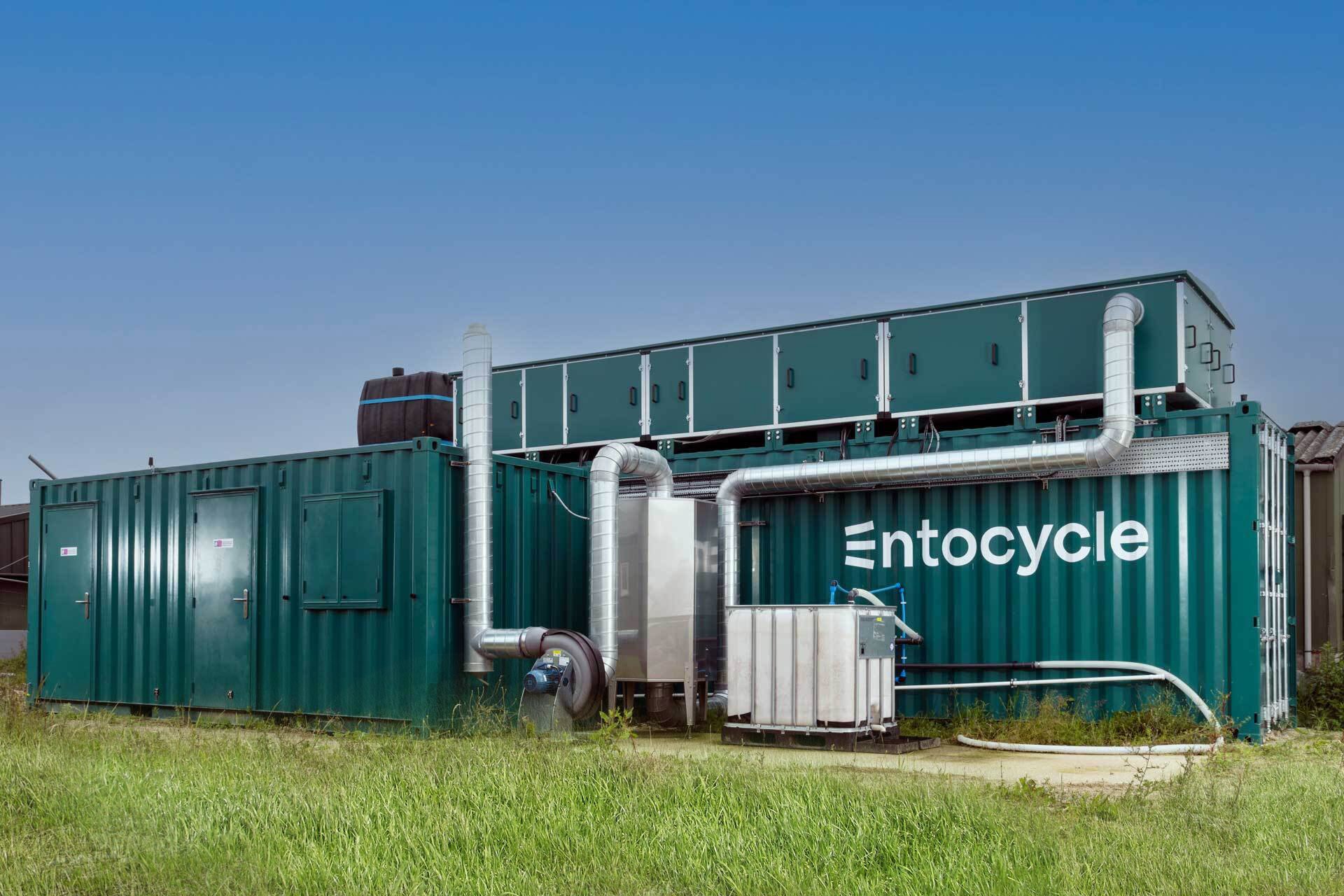
In August 2022, we secured a tender with The University of Leeds (UoL) to create a bespoke black soldier fly (BSF) Bioreactor research facility for the National Pig Centre in their research farm in Yorkshire, supporting research projects like the InSafe and DELIVER programs that are backed by the UK’s national funding agency, UKRI-BBSRC.

We designed, developed and installed the state-of-the-art insect-rearing demonstrator facility, named The EntoExplore. The lab-scale unit facilitates vital research to develop the protocols and codes of practice to unlock the growth of the UK insect farming industry and its potential to decarbonise livestock production.

This dedicated insect rearing unit enables researchers to perform black soldier fly rearing trials, evaluating an array of feedstock and rearing conditions in a robust, well-monitored and controlled environment - Essentially investigating the use of pig effluent as a BSF feedstock.

The entire unit is designed to be housed in two customised shipping containers, with a capacity of 1000kg feedstock input, 100 crates per batch.

The design of the facility commenced in March 2023, the container build started in June, ground works on site began in September and the facility was commissioned and signed off in March 2024, one year after the design was started.

Our innovative approach was praised by the team at UoL, claiming that we were “highly professional.” And the facility is “making a crucial contribution to the legislative development of the insect industry in the UK.”

Entocycle insect rearing unit university of Leeds feedstock trials

We worked with the University of Leeds Centre for Innovation Excellence in Livestock (CIEL) to supply them with a commissioned unique demonstrator platform facility and a black soldier fly (BSF) research facility. 

With goals to make the first insect bioreactor of its kind in the UK, UoL was keen to implement this facility due to it supporting their ambitions to become the leading UK academic institution on sustainable agri-systems, including insect farming - We engaged with this unique project as a strategic step into new markets and to be a pioneering name in the approval of new feedstocks for insect farming.

This site is specifically designed to handle currently non-permissive waste streams, such as pig manure and slurry. Gaining useful commercial data exaggerates the requirement for a purpose-built system like the EntoExplore. This small site is modular, replicating industrial-scale production (much like our Centre for Insect Technology in London) to provide accurate assessments of usage and impacts.

The EntoExplore bridges the gap between small lab-scale experiments and the real world.

The insect bioreactor is the first of its kind in the UK, supporting our ambitions to become the leading UK academic institution on sustainable agri-systems, including insect farming.
— Gesa Reiss, SMART Agri-Systems Senior Innovation Fellow, University of Leeds

Project Objectives

1 - Research Focus

  • To function as a black soldier fly research facility gathering data via on-board sensors and experimental analysis.

2 - Feedstock Trials

  • Intended to trial pig slurry as a feedstock.

3 - Capacity

  • Suited to accept a wide variety of input types (liquid and dry-matter form) with a capacity for 1000kg feedstock input per batch.

  • 100 crates, each up to 10kg.

  • Output of 108kg wet larvae and 324kg frass per batch.

4 - Operation

  • Automation to allow for repeatability of feed recipe mixing, uniformity of climate systems and operation by operators without insect specific knowledge.

Implementation

Project initiation began in March 2023, and the physical facility construction work ran from September 2023 - March 2024.

We designed the layout to follow a linear structure, starting at pre-processing, leading to bioconversion then post-processing, with a HVAC system to sit above the bioconversion chamber. The automation systems of the facility were built externally from the main chamber with centralised control of all equipment separated from the bioconversion area. 

The pre-processing area focuses on being a short-term storage facility for the input of liquid feedstock, with an automated dosing of liquid feedstock into the mixing-tank system. There would be some manual labour involved, however the majority of the system is automated, including the washing cycle.

The bioconversion section utilised a ‘first in first out’ storage racking system, which could hold 100 crates at 10kg each. The design allowed for easy insertion of crates from the pre-processing end, to easy removal of crates from the post-processing end. Ensuring for a climate controlled environment, we utilised flow-rollers to allow crates to “slide” along shelves that have optimal separation between them to allow for measured airflow which is reversible due to the air ducts at either end of the system. 

Post-processing features the contents of the crates now being fully-grown larvae and frass being tipped onto a vibratory sieve, to separate the frass and larvae, depositing both into clean crates.

The climate control module is mounted on-top of the primary shipping container, providing for temperature and humidity control. The airflow is directed over the crates during the bioconversion phase, with the temperature and humidity being varied over the bioconversion period to optimise insect growth and welfare. The direction of the airflow is intermittently reversed to reduce gradient of conditions across the crates, with the general operation of the climate control system being automatically set for a given lifespan, but it can be manually overridden for testing purposes.

The automation system in the facility provides precision control of all equipment in the unit. This includes the pre and post processing stages, when an operator shall be present, as well as the bioconversion stage in which the unit shall operate autonomously for several weeks. We installed a user-friendly graphical interface, displayed on a touchscreen HMI within the unit, allowing for easy control and monitoring. Pre-defined routines can be adjusted to suit the specific research needs of the operator, along with there being critical safety parameters being monitored and alerts being raised in cases of emergency.

exterior of entocycle's bioreactor university of leeds
construction for entocycle university of leeds bioreactor unit

Challenges

This was a first of its kind project for us. We had to refine a few elements of the container module to ensure that it would work as efficiently and effectively as possible, resulting in us learning a lot.

Facilities on a working farm are vastly different to those in a controlled lab environment. It was a challenge to balance the needs of the washing and sterilisation equipment with the outputs of entomological testing, and the physical space of the bioreactor.

The installation and commissioning period was over a cold, snowy winter in Yorkshire. Conditions were far from optimal, and it required a lot of strength from our team to pull out long days on-site, ensuring systems were operational.

During this project, our entomologists learned many lessons regarding the logistics of transporting larvae for testing. They had to refine the method of transport and packaging during the different phases of commissioning, which has been successfully applied to projects since this testing was live.

There were initial slight expectation differences for the minimum scale of testing, which required us to work and collaborate with UoL to best meet their requirements within the parameters of the bioreactor - this resulted in successful final commissioning tests.

Results

This is the debut of the EntoExplore, which has allowed us to build a strong link with a world-class research partner - whom we had been previously collaborating with since 2022. Through this ongoing partnership, we can continue to develop world-leading knowledge of the insect protein industry.

Engineering the first of its kind facility in the UK, the EntoExplore’s curated design to handle currently non-permissive waste streams acts as the framework for the industry moving forward. This specific project is modular, replicating industrial-scale production that ensures accurate assessments of usage and impacts - bridging the gap between lab-scale experiments and the real world.

Impact

As this was our first container module solution, we learnt a lot that we have since embedded in our processes moving forward.

The EntoExplore is a market-ready product that targets a variety of customers, including:

  • Academic and research organisations.

  • Early stage commercial producers and entrepreneurs looking for a cost-effective method of conducting market feasibility studies, ultimately leading to further collaborations on full-scale-factory projects.

  • Waste management companies wanting to integrate insect-based waste processing as a cost-effective, sustainable and organic waste processing solution.

  • Farmers and food producers looking for on-site waste valorisation methods and entry into new, fast-growing markets for diversifying income through agri-tech innovation.

Looking at how far the industry has come since we launched the EntoExplore, there’s certainly been a significant increase in interest from farmers and growers who are either considering alternatives to anaerobic digestion (AD), or looking to integrate insect bioconversion with their existing AD processes. There’s also the opportunity for insect frass to be used as a feedstock in AD systems, with a well-integrated setup allowing farmers to maximise the valorization and upcycling of all waste streams.

The EntoExplore is making a crucial contribution to the legislative development of the insect industry in the UK.
— Gesa Reiss, SMART Agri-Systems Senior Innovation Fellow, University of Leeds
spen farm university of leeds
Previous
Previous

The Royal Botanic Garden Edinburgh

Next
Next

The Centre for Insect Technology